
Overview
Bonding Requirements for Traffic Signal Systems
All non‐current carrying metal parts of a traffic signal system(s) mounted at a height of less than 2.5 m above grade shall be bonded (Rule 10‐400). Bonding conductors run underground for traffic signal systems may be located outside of the conduit or cable assembly containing the circuit conductors (Rules 12‐524, 12‐1122, 12‐1166, 12‐1514).
Direction
Based on past practice and satisfactory experience, it is acceptable for bond conductors installed underground for traffic signal installations to be external of the conduit or cable assembly. The bond conductor must be minimum #6 copper and located in the same trench as the circuit conductors and positioned to be mechanically protected during and after backfill of the trench. The routing of the bond conductor shall be from the metal poles back to the main service switch and then to the controller cabinet (Rule 10‐402). See diagram 1 or 2. (Depending on the Utility’s requirement)
Rationale
To maintain the system integrity during a lightning strike or during an electrical fault in the traffic signal system that may result in hazardous conditions that pose a risk to public safety.
In the event that a metal pole is struck by lightning, the discharge of energy would be dissipated into the mass of the earth through the #6 bond conductor loop and associated ground electrodes, thereby protecting the control equipment located in the controller cabinet.
This bond path and method of installation is acceptable and will allow all overcurrent devices to operate under fault conditions.
Approval
Service entrance switches and controller units shall be certified or approved for their intended use, or a deviation must be requested as per 2‐030.
Direction
Cables manufactured to the International Municipal Signal Association (IMSA) cable specifications shall be deemed acceptable. The applicable standard shall be surface printed on the cable jacket. Traffic signal heads shall be accepted as part of the wiring installation as per Rule 2‐024.
Rationale
Cables manufactured to the IMSA and OPS standard have been installed and accepted for many years and have become industry standard. The manufacturer specifications meet or exceed the CSA standard, and there is no evidence of undue fire or shock hazard.
Traffic signal heads by nature, must be able to withstand the elements. They form an integral component of a life safety system, necessitating a high degree of robustness.
These items pose no fire or shock hazard and shall be accepted as part of the wiring installation as per Rule 2‐024.
Controller Unit, Bonding Jumper
The NEMA Standard requires controller units to have a bond jumper installed between the neutral bus and the bond bus. This requirement is to accommodate the RF filter installed in the controller. When the controllers are certified or field evaluated, the installation of a bond conductor between the bond and neutral buss is permitted based on the recognized equipment standards for traffic controller units.
Rationale
These are the industry standard in North America for certified or field evaluated traffic controller units; O NEMA TS 1 Traffic Controller Control Systems: 1989.
Equipment Support
Stainless steel bands shall be permitted to be used for the sole support of equipment used for traffic signal systems.
Rationale
Historically stainless‐steel bands have been used for the sole support of traffic signal system equipment and have become the accepted trade practice. Failure of the traffic signal system may result in hazardous conditions that pose a risk to public safety, and this method of equipment support has been found to be sufficient.
Diagram 1
One typical grounding and bonding schematic for a traffic signal system that is acceptable in the Province of Saskatchewan.
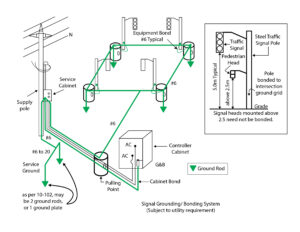
Notes: The Canadian Electrical Code requires a minimum of two ground rods (or one ground plate) to be installed at the service entrance switch; any additional ground electrodes would exceed that minimum requirement, as in diagram 1. Pedestrian push buttons installed below 2.5m in a metallic box are not required to be bonded if supplied from a Class II power source as defined in Rule 16‐200. Bond conductors installed in raceways shall be insulated, if the raceway exceeds two quarter bends or fifteen meters in length.
Diagram 2
Alternate typical grounding and bonding schematic for a traffic signal system acceptable in the Province of Saskatchewan.
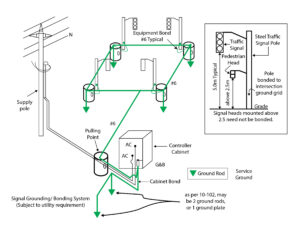
Notes: The Canadian Electrical Code requires a minimum of two ground rods (or one ground plate) to be installed at the service entrance switch; any additional ground electrodes would exceed that minimum requirement, as in diagram 2. Pedestrian push buttons installed below 2.5m in a metallic box are not required to be bonded if supplied from a Class II power source as defined in Rule 16‐200. Bond conductors installed in raceways shall be insulated, if the raceway exceeds two quarter bends or fifteen meters in length.
Definitions
Controller: means a complete traffic signal control equipment package including cabinet, controller unit and all associated power control actuation or interconnection devices.
Controller Cabinet: means an outdoor enclosure used for the housing of the controller unit and all associated power, control, activation or interconnection devices.
Controller Unit: means that portion of the controller assembly devoted to the selection and timing of traffic movements.
Detection: means the operation of a detector sensor unit in registering the presence or passage of a vehicle or pedestrian.
Electrical Chamber: means a chamber for placing and maintaining conductors, cables, ducts or electrical apparatus. General name for electrical maintenance holes, handholes, inground pull boxes and pedestals.
Electrical or Communications Pedestal: means a surface‐mounted chamber affording facilities for access to and maintenance of conductors, cables and associated apparatus.
Highway Lighting System: means a system of luminaires, poles, sign luminaires, underpass illumination, cables, power supply equipment, control system and all associated materials required to provide illumination on a highway or associated appurtenances.
Interconnection: means the system of cables and devices which operate traffic signal controllers at consecutive intersections in a fixed or preprogrammed timing sequence.
Riser Wire: means the wire or wired between a pole handhole or pole‐mounted junction box and electrical equipment mounted on the pole.
Signalized Intersection: means an intersection or junction of two or more roadways or walkways where the vehicular and pedestrian traffic is controlled by a traffic signal system.
Traffic Signal System: means a system of traffic signal equipment, poles, traffic signal controllers, traffic signal actuation and interconnection equipment and all associated materials required to regulate vehicular and pedestrian traffic at an intersection or intersections.
Signal Head: means an assembly containing the signal face.